2025 - Vienna

The 22nd Annual EFNIL Conference
 22nd-24th October, 2025, Vienna, Austria

General theme:
Language Norms and Linguistic Justice in a Multilingual World – 
Historical, Political, Linguistic Perspectives

Hosted by the Austrian Centre for Digital Humanities (ACDH)

Announcement

Programme

(pdf)


14.00-15.00 Registration and sandwich
15.00–17.00 EFNIL General Assembly
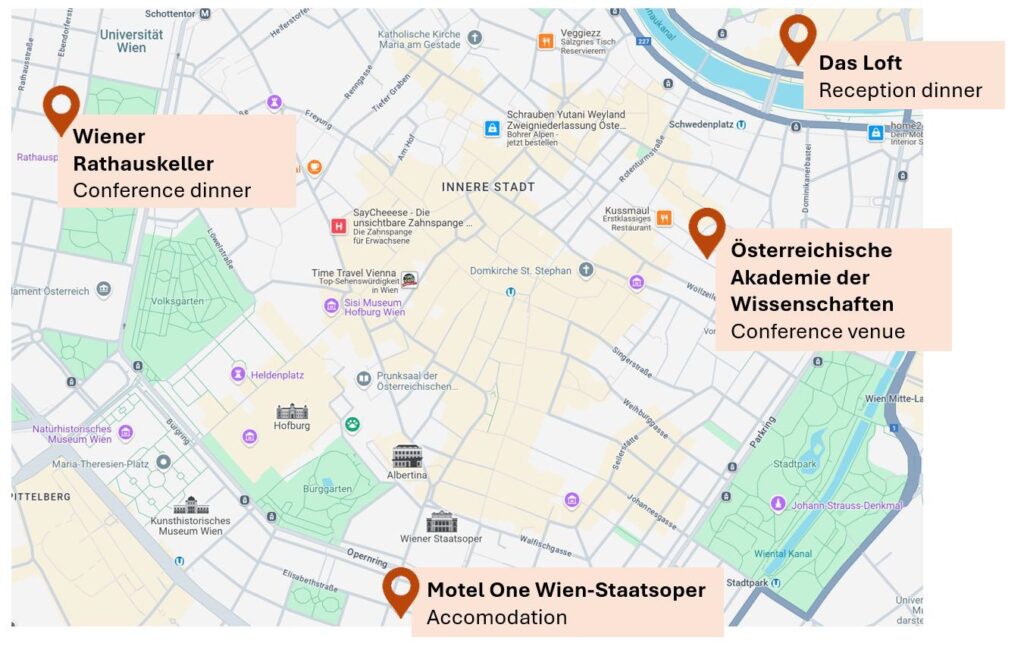
18.00-20.00 Reception dinner at Sofitel Das Loft (Praterstraße 1, 1020 Wien)

Opening Session
9.00-9:45 Welcome addresses by
     Eva-Maria Holzleitner, Federal Minister for Women, Science, and Research,
     Christoph Wiederkehr, Federal Minister of Education,
     Heinz Faßmann, President of the Austrian Academy of Sciences,
     Alexandra Lenz, director of ACDH
     Josefine Hederström, Head of Unit, European Commission (DGT),
     Colin Scicluna, Deputy Director-General, European Commission (DG SCIC),
     Ewa Sinclair, Head of the Spanish Translation Unit, European Parliament (DGT),
     Sabine Kirchmeier, President of EFNIL
Session 1: The Role of Norms
9.45-10.15 Leigh Oakes: Normative language policy: a new framework for assessing linguistic justice in research and practice (keynote speech) (abstract | presentation)
10.15-10.45 Barbara Seidlhofer: Enabling and disabling norms in lingua franca communication (keynote speech) (abstract | presentation)
10.45-11.00 Discussion
11.00-11.20 Coffee break
Session 2: Norms and Language Change
11.20-11.40 Andreas Gardt: Us and Them: The Struggle for Language Norms in Germany in the Face of Foreign Influences (abstract | presentation)
11.40-12.00 Jóhannes B. Sigtryggsson & Ari Páll Kristinsson: Implications of Modern Icelandic spelling norms in terms of inclusion and exclusion (abstract | presentation)
12.00-12.20 Martin Prošek & Hana Mžourková: Latest Influences on Language Norms in the Czech Republic (abstract | presentation)
12.20-12.35 Discussion and questions
12.35-13.35 Lunch
Session 3: Norms, Language Change and Language Services
13.35-13.55 Lena Lind Palicki & Linnea Hanell: Giving Advice on Language and Language Use in the Service of Society (abstract | presentation)
13.55-14.15 Charlotta af Hällström-Reijonen: Historical aspects of language counselling (abstract | presentation)
14.15-14:35 Rodica Zafiu: How we talk. Romanian language today between trends, fashions and the literary norm (abstract | presentation)
14.35-14.50 Ewa Sinclair: Multilingualism in the European Parliament as a means of citizens’ inclusion (abstract | presentation)
14.50-15.05 Discussion and questions
15.05-15.25 Coffee break
Session 4: Lexicography and Language Change
15.25-15.45 Christiane Pabst, chief editor of the Austrian Dictionary: Socio-political Influences on the Codification and Standardization in Dictionaries (abstractpresentation)
15.45-16.05 Margit Langemets: How base, oh heaven! Debating about descriptive and prescriptive data in the dictionary: The case of Estonia (abstract | presentation)
16.05-16.25 Katarzyna Kłosińska: The Status of the Linguistic Norm in Networked Society and its Codification (abstract | presentation)
16.25-16.45 Olena Ivanovska: Language Policy in Ukraine: Influencing Factors, Challenges, and Prospects (abstract | presentation)
16.45-17.05 Discussion and questions
19.00-22.00 Conference dinner at Rathauskeller (Rathausplatz 1, 1010 Wien)

Session 5: Language Technology, Norms and Literature
9.00-9.20 Andreas Witt & Laura Herzberg: Standardization and AI in Language Simplification: The Example of Leichte Sprache (Easy Read) and Einfache Sprache (Plain Language) in German (abstract | presentation)
9.20-9.40 Georgi Alibegashvili & Tinatin Bolkvadze: Standardization of the Georgian language in Soviet and post-Soviet times (abstract | presentation)
9.40-9.50 Yuliia Chernobrov: The Mission, Functions and Tasks of the National Commission for State Language Standards in the Implementation of Language Policy in Ukraine (abstract | presentation)
9.50-10.00 Discussion and questions
10.00-10.20 Panel discussion: Concluding panel of the conference (presentation)
10.20-10.40 Coffee break
Session 6: EFNIL Master’s Thesis Award
10.40-11:00 Vasiliki Aliki Tzoutza, MTA Winner: The case of Gender-Neutral Language in bilinguals speakers of Greek and English (presentation)
11.00-11.20 Olve Godø Sæther, MTA Winner: English for safety or Norwegian as a societal pillar? An analysis of the current state of the parallel language situation at sea, and seafarers attitudes towards their own professional language (presentation)
11.20-11.30 Sabine Kirchmeier: Conclusion of the conference 
12.00-13.00 Lunch
13.00-           Optional social program

22 October 2025
 
23 October 2025

Dinner

24 October 2025

Conference venue

Österreichische Akademie der Wissenschaften (ÖAW)
Dr. Ignaz Seipel-Platz 2
1010 Wien

Accomodation

Motel One Wien-Staatsoper
Elisabethstraße 5
1010 Wien

Dinner venues

Reception dinner on 22 October 2025
Sofitel Das Loft
Praterstraße 1
1020 Wien

Conference dinner on 23 October 2025
Rathauskeller
Rathausplatz 1
1010 Wien
By plane
Vienna international Airport is located in Schwechat, a town neighbouring Vienna in the south-east.

By train
Vienna Main Train Station (Wien Hauptbahnhof)
Am Hauptbahnhof
1100 Vienna
Connection to U1

Westbahnhof
Europaplatz 2
1150 Vienna
Connection to U3

How to get to the the city centre …

… from the airport
You can reach the city centre by CityAirportTrain, train and bus in 15-45 minutes.

City Airport Train (CAT) 
− From Vienna Airport to the City Air Terminal (Wien Mitte, connection to U3, U4, tram 0, bus line 74 and various overground trains)
− Tickets: are available online , from ticket machines and from CAT staff.
− Timetables and further information: link

ÖBB Railjet 
The Railjets are operated by Austrian Federal Railways (ÖBB).
− From Vienna Airport to Vienna Main Station and Wien Meidling Station
− Tickets: are available online, at the ÖBB ticket counter at the airport, at ticket machines and via the ÖBB ticket app.
− Timetables and further information: link

Bus connections (Vienna Airport Lines)
Tickets
    o VAL 1: From Vienna Airport to Vienna Main Station (connection to U1) and to Vienna Westbahnhof Station (connection to U3, U6)
    o VAL 2: From Vienna Airport to Morzinplatz/Schwedenplatz (connection to U1, U4)
    o VAL 3: From Vienna Airport to Donauzentraum (connection to U1)
− Timetables and further information: link

Further information regarding getting to the city centre from the airport: link

… from the train stations
From Vienna Main Train Station (Wien Hauptbahnhof) to Motel One Wien-Staatsoper
Take Underground U1 (direction: Leopoldau) from stop ′′Hauptbahnhof′′ and get off at stop ′′Karlsplatz′′, take exit ′′Kärntner Straße′′.

From Westbahnhof to Motel One Wien-Staatsoper
Take Underground U3 (direction: Simmering) from stop ′′Westbahnhof′′ and get off at stop ′′Volkstheater′′. From there, take Tram 1 (direction: Stefan Fadinger Platz) or Tram 2 (direction: Friedrich-Engels-Platz) or Tram 71 (direction: Kaiserebersdorf, Zinnergasse) at stop ′′Ring/Volkstheater U′′ and get off at stop ′′Oper/Karlsplatz U′′:

Overview

WienMobil App
This app can be used to buy tickets, plan routes and provide real-time information.

Tickets for public transport
You will need a valid ticket to use public transport. There are several ways to buy a ticket.

U-Bahn (Underground)
There are 5 underground lines that run within the city. They can be recognised by the different
colours and numbers as well as the respective end stops.
U1: Leopoldau – Oberlaa
U2: Karlsplatz – Seestadt
U3: Ottakring – Simmering
U4: Hütteldorf – Heiligenstadt
U6: Siebenhirten – Floridsdorf

Tram & bus
There are numerous buses and trams in the city centre of Vienna. The easiest way to find a
connection is to use the WienMobil App.

Taxis
Various taxi companies can take you to your destination. 

For general tourist information and info on the main sights see the official travel guide of the City of Vienna.

We have also compiled some specific suggestions for things to do in Vienna. Please note that these are independent recommendations and not organized by us. However, please feel free to let us know should you need any further information.

Free Walking Tours/City Tours
Tip-based tours through the city centre.

Esperantomuseum
Museum about the planned language Esperanto. There is also the possibility to do a crash course in Esperanto.
Costs: If more than 9 people take part in the guided tour, the museum charges €14.50 per person (including admission). A guided tour including crash course lasts around 90 minutes and the cost for groups of less than 10 people is a flat rate of €200.

Parlament
As the home of democracy, it is one of the most important buildings in Vienna and also an architectural highlight.
Costs: Admission and guided tours are free.

Wien Museum at Karlsplatz
There is a permanent exhibition on the history of Vienna.
Costs: Admission is free, but a guided tour costs €150 for 90 minutes.

Boat trip on the Danube
There are various options for sightseeing cruises in Vienna.
PDF Version